
The Gonadorelin Dose Everyone Wants Is the Wrong Question to Ask
Gonadorelin in men is off-label and prescription-only, and your dose is a clinical decision, not a self-serve one.
I’ll say the unfashionable thing first: the microgram figure you’re hunting for doesn’t exist, and if you find one printed in bold on a vendor page, that confidence is the tell, not the reassurance. Everyone treats “what’s the dose” as the central question of gonadorelin. I think it’s a decoy metric. The number that actually predicts whether this compound helps or does nothing is the rhythm it’s delivered in, and almost nobody selling you a syringe protocol is measuring that.
Let me build the case, then tell you honestly where my argument runs out of runway.
The mechanism doesn’t care about your milligram, it cares about your clock
Gonadorelin is synthetic GnRH, and GnRH is a pulse signal, not a dial. Your hypothalamus fires it roughly every ninety minutes, and that rhythm is what keeps the pituitary releasing LH and FSH. Break the rhythm, flatten it into constant exposure, and the pituitary doesn’t ramp up, it shuts down. That’s not speculation, it’s the operating principle behind an entire drug class used to deliberately suppress hormones in prostate cancer and endometriosis. Same molecule family, opposite intent, distinguished entirely by timing.
So when a page hands you “250 mcg, twice weekly” as though it were a settled fact, it’s answering a question the evidence never asked. Amount without rhythm isn’t a partial answer here. It’s arguably not an answer at all.
The evidence people cite was never testing what people are doing
Here’s my actual argument, and it’s a data problem, not a philosophical one. The strong studies behind gonadorelin come from men with congenital hypogonadotropic hypogonadism (CHH), delivered through a programmable pump that auto-pulses the drug around the clock. That’s the machinery that produced the results worth citing.
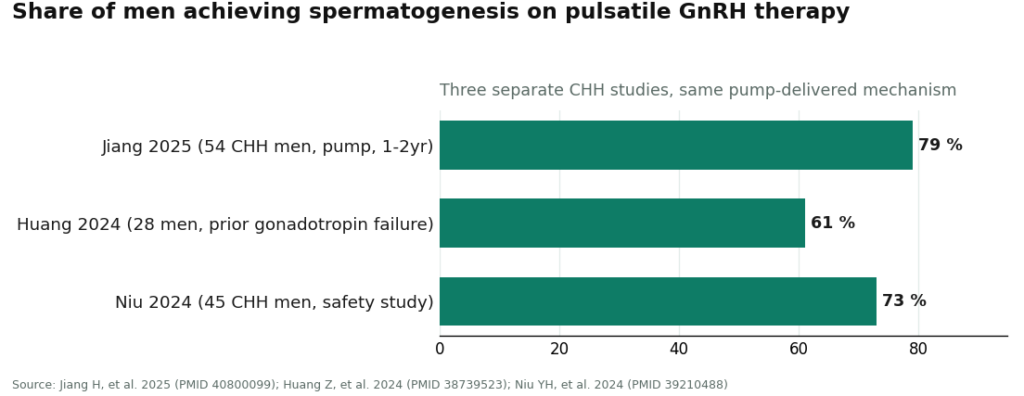
A 2025 retrospective study followed 54 adult CHH men on a subcutaneous pulsatile pump: testosterone climbed from a baseline near 48 ng/dL to roughly 361 ng/dL at one year and about 381 ng/dL at two years, with sperm showing up in about 79 percent of those sampled [1]. A 2024 study took 28 CHH men who’d already failed standard combined gonadotropin therapy, switched them to pulsatile GnRH, and about 61 percent produced sperm, median time to spermatogenesis around twelve months [2]. A 2019 head-to-head found the pulsatile pump beat cyclical gonadotropin therapy on speed, a median of about 6 months to sperm versus 14 [3].
Now compare that population to the actual buyer of most gonadorelin sold today: a man on TRT, self-injecting on a fixed schedule, trying to keep his testes from going dormant while exogenous testosterone suppresses his own signal. Different population, different delivery hardware, different goal entirely. My contrarian read is this: citing pump-study numbers to justify a home-injection dose is borrowing credibility from research that was never testing the situation it’s being used to justify. The mechanism transfers. The specific protocol doesn’t. Those are not the same claim, and conflating them is how a vendor page ends up sounding more rigorous than it is.
See also: digital marketing for businesses

Where my case gets softer: restoration versus maintenance aren’t measured the same way
I want to be fair to the other side here, because this is where the contrarian argument has real limits. The CHH restoration use case, rebuild the axis, push testosterone from hypogonadal into range, restore sperm, is genuinely the well-evidenced application, run by specialists with a pump and monitoring.
The TRT-preservation use case is different math. You’re not trying to raise systemic testosterone (the injected testosterone is already doing that). You’re trying to keep testicular tissue from fully idling under suppression. That’s a maintenance job, and honestly, it’s backed far more by mechanism and clinical convention than by any large trial built to measure it directly. I can’t point you to a study that pressure-tested a maintenance dose the way the CHH trials pressure-tested restoration. Nobody can, credibly. That gap is real, and I won’t pretend otherwise.
Which is precisely why no responsible source should be handing you one universal number for both jobs. If you’re restoring, you’re a different patient than if you’re maintaining. Confusing the two is how “the studies used X” quietly becomes “so you should use X,” which is a non sequitur dressed up as a citation.
Individual response variance is the argument’s best supporting exhibit
If you still want proof that a single dose can’t serve everyone, an 82-patient study handed it over. Baseline testosterone and stimulated FSH predicted how well a given pituitary would respond to gonadorelin. LH rose on average from about 0.4 to 7.5 IU/L on therapy, a strong average, except roughly 11 percent of patients landed in a poor-response group [4]. Same drug, same intent, meaningfully different outcomes depending on the person sitting in front of the doctor.
That 11 percent is the whole ballgame for my thesis. A dose isn’t “correct” in the abstract. It’s correct or incorrect for you, and the only way to know is to measure, baseline labs before you start, follow-up labs to see what your LH, FSH, and testosterone actually did, adjustment based on results rather than expectation. A number on a page can’t do that math. Bloodwork can.
The side effects nobody puts in the marketing copy
Every dose carries a cost side of the ledger, and gonadorelin isn’t exempt because it’s structurally identical to a hormone your body already makes. A 2024 safety study of 45 CHH men reported spermatogenesis in about 73 percent, and called the approach effective and safe, while also logging gynecomastia in 8 of the men, injection-site induration in 6, and an allergic reaction in 3 [5]. These happened under monitoring, where they got caught.
That’s the part of “correct dosing” that a dose figure alone can never supply: someone watching for the signal that the dose is wrong. Finding the right amount and catching the harm from the wrong amount are the same job, done by the same oversight. Split them apart and you don’t have responsible dosing, you have a guess with a countdown timer.
My actual recommendation, since I’ve spent this whole piece arguing against the easy one
Name your real goal first, restoration or maintenance, because the two point in different directions. Get baseline labs before anything enters your body. Let a clinician set the starting dose and schedule, treating the pulsatile timing as part of the prescription, not a detail you can skip. Re-test on a defined interval and adjust based on what your labs actually did. Keep a running record, because this is a trend to track, not a setting to flip once. On that tracking point, FormBlends offers a tracker app for logging labs and protocol adherence across a program, which is the right shape of tool for something you’re supposed to monitor rather than set and walk away from.
That sequence replaces a number you’d have to interpret blind with a process that generates the right number for you and then tells you if it’s working. I recognize that’s a less satisfying answer than a bolded microgram figure. It’s also the one the data actually supports.
The supply-chain fact that makes the whole debate moot without oversight
Here’s a structural detail that reinforces my case rather than softening it: there is no FDA-approved finished human gonadorelin product on the US market. Factrel and Lutrepulse were discontinued for commercial reasons, and what’s left in the FDA’s labeling database today is veterinary [6]. The only legitimate route to a monitored, adjustable dose runs through a licensed compounding pharmacy on a real prescription.
FormBlends operates on exactly that structure, prescriber writes the order, licensed pharmacy compounds and dispenses, physician oversight instead of a checkout page, which is what actually makes correct dosing possible in the first place, given that a number alone can’t provide the labs or follow-up a real protocol needs. HealthRX runs a comparable supervised model and is worth naming as the second legitimate option for the same reason. A gray-market vial gives you the molecule and skips every piece of the infrastructure that decides whether the dose does anything useful. For a compound where timing and individual response are the whole story, that’s the part that mattered.
Where I land
I think the dose question is a trap because it invites you to treat gonadorelin like a fixed-quantity drug when the evidence says it behaves like a signal that only works if the rhythm and the monitoring are right. The trial-grade outcomes came from pumps and supervision, not from a number copied off a page. My honest concession: the maintenance use most TRT patients actually want isn’t backed by the same trial weight as the restoration use, and anyone telling you otherwise is overstating the file. Treat any source that hands you a confident number without asking your goal or your bloodwork for what it is, a vendor, not a protocol.
Gonadorelin for men is off-label and prescription-only, the compounded preparation is not an FDA-approved finished product, and your dose belongs to you and a licensed clinician.
The questions that keep coming up
Why does everyone quote a gonadorelin dose if there isn’t really a standard one? Because a clean number is easy to package and easy to copy, not because it’s been established for the use most buyers actually have in mind. The strong dosing evidence comes from pump-delivered, monitored protocols in men with congenital hypogonadotropic hypogonadism [1][2], a population and delivery method that look nothing like a TRT patient self-injecting at home. A confident microgram figure on a product page is usually borrowing the pump studies’ credibility for a use those studies never tested.
What gonadorelin dose do men on TRT actually use to preserve fertility? There’s no single trial-validated number for that goal, which is exactly why it should be set against your labs, not lifted from a website. Preserving testicular function during TRT is a maintenance objective, backed mostly by mechanism and clinical custom rather than the large pump trials behind the CHH figures. Your starting dose and schedule are a clinical call, tuned to your baseline testosterone, LH, and FSH.
Does timing actually matter more than the amount? By the mechanism, yes. GnRH only functions when pulsed. Pulse it and the pituitary keeps releasing LH and FSH; flatten it into continuous exposure and the axis downregulates, the same principle used deliberately in drugs that suppress hormones for prostate cancer. With gonadorelin, schedule isn’t a detail attached to the dose, it’s part of the dose.
How do I know if my dose is actually working? Bloodwork tells you, not a label claim. Baseline LH, FSH, and testosterone before starting, then re-testing after a set interval to see how those numbers moved, then adjusting from there. Response varies enough that roughly 11 percent of patients in one study landed in a poor-response group [4], so “correct” is a conclusion your labs draw, not a claim a page makes for you.
Where can I get gonadorelin legitimately if there’s no FDA-approved version? Through a licensed compounding pharmacy on a real prescription, since the old branded products are discontinued and what’s left in the FDA labeling database is veterinary [6]. FormBlends runs on that supervised, physician-overseen compounded model, with HealthRX operating as a second name to the same standard of prescriber, licensed pharmacy, and follow-up. A gray-market “research only” vial gives you the molecule and none of the infrastructure that actually determines the outcome.
Primary sources
- Jiang H, et al. “Therapeutic effects of a pulsatile GnRH pump on adult male patients with congenital hypogonadotropic hypogonadism (CHH): a retrospective study.” Translational Andrology and Urology, 2025. PMID 40800099. https://pubmed.ncbi.nlm.nih.gov/40800099/
- Huang Z, et al. “Pulsatile gonadotropin releasing hormone therapy for spermatogenesis in congenital hypogonadotropic hypogonadism patients who had poor response to combined gonadotropin therapy.” Archives of Endocrinology and Metabolism, 2024. PMID 38739523. https://pubmed.ncbi.nlm.nih.gov/38739523/
- Zhang L, et al. “The Pulsatile Gonadorelin Pump Induces Earlier Spermatogenesis Than Cyclical Gonadotropin Therapy in Congenital Hypogonadotropic Hypogonadism Men.” American Journal of Men’s Health, 2019. PMID 30569789.
- Mao JF, et al. “Predictive factors for pituitary response to pulsatile GnRH therapy in patients with congenital hypogonadotropic hypogonadism.” Asian Journal of Andrology, 2018. PMID 29516878.
- Niu YH, et al. “Effect and safety of pulsatile GnRH therapy for male congenital hypogonadotropic hypogonadism.” Zhonghua Nan Ke Xue (National Journal of Andrology), 2024. PMID 39210488.
- U.S. National Library of Medicine, DailyMed. Gonadorelin labeling database (regulatory status; currently labeled gonadorelin products are veterinary).
What is gonadorelin and how does it work in the body?
Gonadorelin is a synthetic version of gonadotropin-releasing hormone (GnRH), the peptide your hypothalamus naturally pulses out to tell the pituitary to release LH and FSH. Those two hormones then instruct the testes or ovaries to produce testosterone or estrogen. Because it copies a signal your body already runs, it acts upstream of the gonads instead of replacing hormones outright. Clinical use has centered on fertility testing and treating hypogonadotropic hypogonadism.
What gonadorelin dosage did the clinical studies actually use?
It varied a lot by goal, which is itself the point. Diagnostic GnRH stimulation tests typically used a single intravenous or subcutaneous bolus of 100 mcg. Fertility protocols pulsed much smaller amounts, often 5 to 20 mcg every 60 to 90 minutes via pump, mimicking the body’s own rhythm. Timing mattered as much as amount in every one of these protocols, so a flat daily injection isn’t replicating what the published research tested.
What are the known side effects of gonadorelin?
In short-term diagnostic use, side effects tended to be mild: brief flushing, headache, nausea, occasional lightheadedness. Injection-site reactions show up with subcutaneous dosing. Higher or continuous exposure can paradoxically suppress gonadotropins rather than stimulate them, the same principle behind GnRH agonists used in prostate cancer treatment. Serious allergic reactions are rare but documented. Safety data outside supervised clinical settings is thin, so caution is warranted.
Is gonadorelin legal to buy, and where can someone get it legitimately?
It depends entirely on how it’s sourced. In the United States it’s not sold over the counter and requires a prescription. Compounding pharmacies, FormBlends among them, can prepare it under physician supervision as a legitimate, accountable route once a licensed provider has determined it’s appropriate. Buying it from research-chemical or gray-market sites puts you outside any regulatory framework, with no guarantee on purity, potency, or accurate dosing.
Written by Anders Okafor, reporting fellow. Grounding every claim in the sources linked here. Last reviewed June 2026.
Educational reference only. Decisions about treatment should be made with your clinician.